

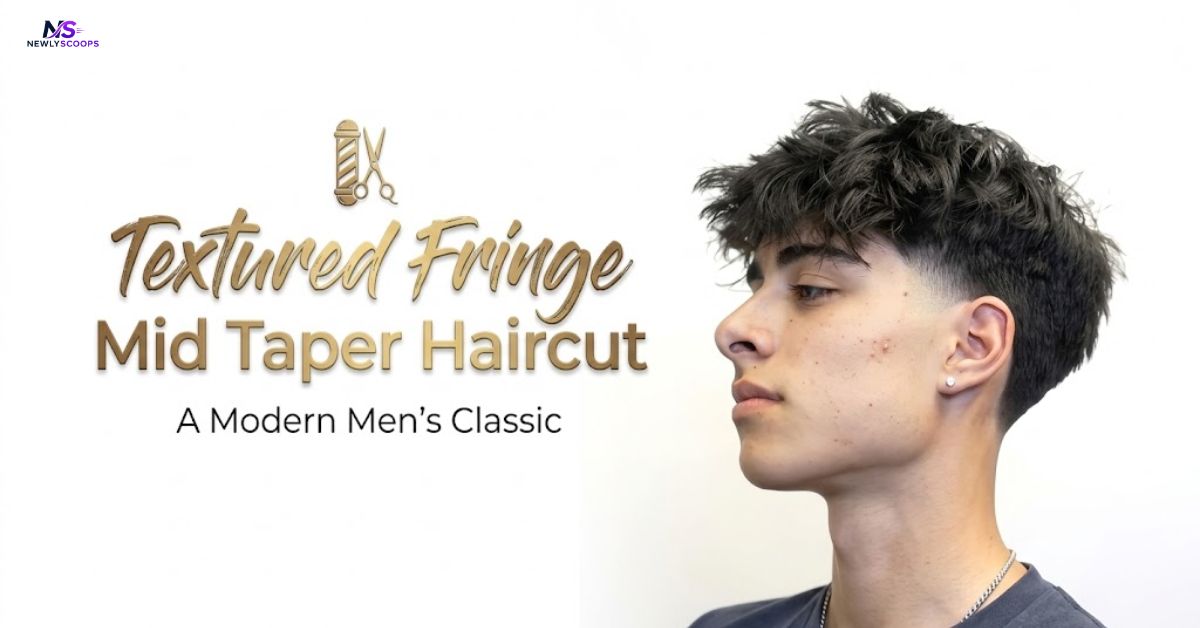
A Textured Fringe Mid Taper combines controlled sides with a textured top, giving men a haircut that feels current without becoming overly sharp. The look uses a textured fringe, a mid taper, and enough length through the top to create natural movement and hair volume. That combination makes it useful for men who want a modern haircut that can move between relaxed and polished settings.
The appeal of this men’s haircut comes from its flexibility. Straight hair, wavy hair, curly hair, thick hair, and fine hair can all be shaped differently while keeping the same basic silhouette. A barber can adjust the hair length, fringe length, top length, and taper height so the result complements the wearer instead of simply reproducing a photograph.
What Is a Textured Fringe Mid Taper?
A Textured Fringe Mid Taper is a men’s haircut built around a longer top, short sides, and controlled tapering around the ears and back. The front is cut as a fringe haircut, while the top receives hair layering and texturizing to encourage natural movement. Rather than making every strand identical, the barber creates separation so the hair has definition and direction.
The mid taper sits higher than a low taper but does not climb as aggressively as a high taper or skin fade. This produces a balanced transition that leaves enough weight around the sides for a soft appearance. The result is a taper haircut with a cleaner outline while the top retains texture, hair movement, and styling versatility.
Unlike a skin fade, the taper fade does not have to expose a large amount of scalp. That makes the haircut adaptable for men who want contrast without an extremely tight finish. The barber can also taper the neckline and clean-up around the ears without sacrificing the personality of the longer top.
Key Features of a Textured Fringe Mid Taper
- Layered fringe with natural movement
- Mid taper around the ears and neckline
- Short sides balanced against a longer top
- Textured layers that encourage natural texture
- Hair volume without a rigid shape
- Face framing through controlled fringe length
- Neat sides with tapered sides
- Tapered neckline for a clean finish
- Easy styling with suitable styling products
- A matte finish when a natural appearance is preferred
- Adaptability for straight, wavy, curly, thick, and fine hair
- A balanced hairstyle that can look casual or professional
- A masculine shape that does not require an extreme fade
- Styling versatility for school, work, social occasions, and formal events
Why the Textured Fringe Mid Taper Is So Popular
A Textured Fringe Mid Taper works because it combines structure with movement. The sides provide a clean-cut look, while the top can remain loose enough to create a relaxed finish. Men who dislike extremely polished hair can use finger styling, while those who prefer stronger hair control can use matte products.
Another advantage is the number of possible hairstyle variations. A barber can create a shorter fringe, layered fringe, curly fringe, wavy fringe, or straight fringe without changing the basic concept. Small changes in taper height and top length can also turn the same haircut into a distinctly personalized haircut.
Some reasons men choose it include:
- Creates natural volume
- Enhances natural texture
- Gives the face useful face framing
- Works across multiple hair types
- Allows easy styling
- Offers styling versatility
- Can create a professional hairstyle
- Can also become a casual hairstyle
- Fits modern fashion
- Works with facial hair
- Allows different fringe length options
- Can reduce unwanted hair weight
- Supports hair definition
- Can be adapted to facial proportions
- Provides a contemporary hairstyle without excessive sharpness
- Works for teenagers and adults
- Can suit both casual occasions and formal occasions
The style also photographs well because the textured top creates visible separation from different angles. For men who discover haircut ideas through photographs, social media, or barbershop galleries, that dimensional quality makes the haircut particularly appealing.
Who Should Get a Textured Fringe Mid Taper?
The best candidate is not determined by age alone. Face shape, hair texture, hair density, styling habits, and preferred hair length all matter. A skilled barber can change the amount of layering, taper height, and fringe length to produce a personalized haircut rather than forcing one standard version.
Men who want a modern appearance but still need a practical everyday hairstyle often find this shape useful. The combination of tapered sides and a textured top gives enough contrast to look intentional while preserving softness.
Best Face Shapes
Oval Face
An oval face has relatively balanced facial proportions, so it can accommodate many fringe shapes. A medium fringe length can provide face framing without making the forehead or jawline appear disproportionately narrow.
For an oval face, the barber can experiment with a relaxed fringe, textured layers, or a slightly lifted front. The key is maintaining facial balance rather than adding unnecessary height.
Round Face
A round face can benefit from controlled height through the top. Keeping the sides neat and allowing the longer top to carry some hair volume can create more face definition.
A slightly irregular fringe can also prevent the haircut from looking too symmetrical. A mid taper provides enough structure without making the sides excessively bare.
Square Face
A square face already has a prominent jawline and strong facial proportions. Soft textured layers can reduce visual hardness while maintaining a masculine shape.
A fuller fringe can work especially well when the top has natural movement. Avoiding an overly severe skin fade can preserve the balanced hairstyle.
Heart-Shaped Face
A heart-shaped face generally has more width around the forehead and a narrower lower face. A layered fringe can distribute visual weight across the upper face.
The barber can use a slightly fuller fringe length and moderate hair volume while keeping the sides controlled. This creates a softer appearance and supports facial balance.
Diamond Face
A diamond face often has prominent cheekbones with a narrower forehead and jawline. Texture near the forehead can add useful width and face framing.
A textured haircut with controlled layering can also soften the transition between the cheekbones and forehead. The goal is a balanced hairstyle rather than maximum contrast.
Best Hair Types
Straight Hair
A Textured Fringe Mid Taper straight hair version can make naturally flat strands appear more dimensional. Point cutting, texturizing, and hair layering create separation without requiring excessive product.
Texture powder can add lift, while matte clay can provide hair control. A lightweight styling cream is another option when a softer appearance is preferred.
Wavy Hair
Wavy hair already contains natural texture and hair movement. The barber can preserve that pattern while reducing unnecessary weight around the sides.
A styling cream often provides enough control for a relaxed finish. Men with waves should avoid overworking the hair because excessive brushing can remove the natural movement that makes the style attractive.
Curly Hair
A Textured Fringe Mid Taper curly hair version uses natural curls as the primary source of texture. The sides are controlled while the top keeps enough length for curls to form naturally.
Defining curls is more important than forcing them into straight layers. A styling cream can support hair definition, while lightweight styling products help avoid excessive buildup.
Read More: Low Drop Fade Haircuts for Men Best Styles & Ideas
Thick Hair
Thick hair provides strong natural volume but can become difficult to manage when too much hair weight remains on top. A barber can use layered styling and removing bulk to make the longer top easier to control.
The goal is not to make thick hair look thin. Instead, hair layering should distribute the weight so the textured haircut keeps its shape.
Fine Hair
Fine hair can work with this haircut when the barber avoids removing too much density. A shorter fringe and carefully positioned textured layers can create the impression of greater hair volume.
Texture powder and lightweight styling products can add body without making fine strands collapse. Heavy matte products should be used carefully.
Best Textured Fringe Mid Taper Styles
There are many haircut variations because the top, fringe, sides, and neckline can all be adjusted independently. The following options show how small technical changes can create very different appearances.
Classic Textured Fringe Mid Taper
The classic version keeps a medium top length, moderate fringe length, and a balanced taper around the sides. It is a versatile men’s hairstyle for someone who wants texture without an exaggerated shape.
The barber should concentrate on clean transitions and controlled hair layering. This version is particularly useful for work, school, and everyday situations because it can be styled as either a professional hairstyle or a casual hairstyle.
Textured Fringe Mid Taper Fade
The fade version increases the contrast between the top and sides. The barber can use a taper fade around the midsection while preserving a fuller textured top.
This creates a cleaner finish around the ear area and can emphasize hair definition. It is a useful choice for thick hair when additional side control is needed.
Messy Textured Fringe Mid Taper
The messy version deliberately leaves the top imperfect. Instead of arranging every strand, the wearer uses the fingers to create separation and natural movement.
A small amount of matte clay or texture powder can create a matte finish without turning the hairstyle into a rigid shape. This is one of the easiest options for casual outings and relaxed clothing.
Short Textured Fringe Mid Taper
A shorter fringe reduces styling time and can make the haircut easier to maintain. The top still receives textured layers, but the fringe does not extend far across the forehead.
This haircut variation suits men who want easy styling and a clean-cut look. It can also work well for active lifestyles because there is less hair to rearrange throughout the day.
Curly Textured Fringe Mid Taper
Curly hair gives this hairstyle a naturally dimensional finish. The barber should focus on maintaining curl shape instead of cutting the curls into excessively uniform layers.
The sides can remain neat while the top retains natural curls and natural volume. This creates a masculine shape without sacrificing hair movement.
Textured Fringe Mid Taper Straight Hair
Straight hair benefits from deliberate texturizing because it can otherwise fall into a flat shape. The barber can use point cutting and layered styling to create separation through the top.
A light pre-styling product followed by texture powder can increase hair volume. The final look can remain controlled without losing natural texture.
Textured Fringe Mid Taper Asian
A Textured Fringe Mid Taper Asian variation can work particularly well for straight, dense hair. Asian hair types often have enough natural density to support a fuller top, but that density may also create unwanted hair weight.
A skilled barber can use removing bulk and hair layering while maintaining enough top length. The result is a modern appearance with neat sides and a substantial textured top.
Textured Fringe Mid Taper Mullet
A mullet variation keeps additional length at the back while retaining a textured fringe at the front. This creates a stronger haircut variation for men who want something less conventional.
The taper can prevent the style from becoming visually heavy around the ears. It works best when the longer back is deliberately blended rather than left disconnected.
Textured Fringe with Blowout Taper
A blowout version emphasizes volume around the front and crown. Blow drying the roots upward and slightly backward can create natural volume before the fringe is directed forward.
This option works well with medium hair length and thick hair texture. A matte finish product can preserve volume while avoiding excessive shine.
Textured Fringe with Low Taper
A low taper leaves more hair around the lower sides than a mid taper. The result has a softer appearance and lower contrast.
This option can suit men who prefer traditional proportions or want a more conservative professional hairstyle. It is also useful when the wearer wants a gradual transition into facial hair.
Textured Fringe High Taper
A high taper removes more side weight and creates stronger contrast with the longer top. The result is sharper and more noticeable.
Men with thick hair may appreciate this option because it helps control density around the sides. However, the stronger transition can require more frequent taper upkeep.
Blonde Textured Fringe Mid Taper
Blonde color can make textured layers more visible because changes in light emphasize separation. Highlights can be subtle or pronounced depending on the desired modern appearance.
The haircut itself should still carry the structure. Color should enhance the texture rather than compensate for poor layering.
Textured Fringe with Beard
Facial hair can make the haircut appear more substantial. A clean beard transition into the sideburn area helps connect the masculine shape of the haircut with the jawline.
The barber can coordinate the tapered sides with the beard without creating an overly sharp finish. A shorter fringe can also keep attention on the eyes and facial hair.
French Crop Inspired Textured Fringe
A French crop inspired version uses a shorter top and compact fringe while retaining visible texture. It can be particularly useful for men who want less hair length but still enjoy layered styling.
The fringe length can be adjusted according to forehead size and face shape. This makes it an adaptable hairstyle variation rather than a single fixed cut.
Layered Textured Fringe Mid Taper
Extra hair layering creates more movement throughout the top. This variation is useful when thick or coarse hair has too much weight.
The barber can combine cutting layers with removing bulk so the hair remains full but does not become difficult to style. The result is a textured haircut with better hair definition.
Textured Fringe Mid Taper Kid
For a kid, the haircut should prioritize comfort and manageable hair length. A moderate fringe, soft taper, and easy styling can create a neat appearance without requiring complicated products.
Parents may prefer a low-maintenance hairstyle that works for school and weekends. A barber should also avoid making the neckline or sides unnecessarily aggressive for younger wearers.
Mid Taper vs Low Taper vs High Taper
Choosing between taper heights changes the amount of contrast and the overall maintenance level. The mid taper occupies the middle ground, while a low taper preserves more side length and a high taper produces a stronger transition.
| Feature | Mid Taper | Low Taper | High Taper |
| Starting point | Middle of the sides | Lower near the ears | Higher on the sides |
| Overall effect | Balanced and modern | Soft and subtle | Sharp and bold |
| Contrast | Medium | Low | High |
| Side length | Moderate | More preserved | More reduced |
| Maintenance | Moderate | Lower | Higher |
| Best use | Versatile everyday styling | Conservative styling | Strong modern contrast |
A mid taper is often a strong choice for men who want styling versatility without the sharpness of a skin fade. A low taper can be better for a softer appearance, while a high taper works when contrast is the priority.
Textured Fringe Mid Taper for Different Hair Types
Hair type determines how the top behaves after cutting. The same fringe length can look short on tight curls, medium on waves, and considerably longer on straight hair because different textures compress and expand differently.
A good barber considers natural texture, density, hair weight, and growth direction before choosing the final top length. This is why copying a photograph without considering your own hair type can produce a different result.
Straight Hair
Straight hair tends to show the exact direction of the cut. Adding textured layers can create natural movement where the hair would otherwise lie flat.
For a straight-hair version:
- Ask for point-cut layers.
- Keep enough top length for movement.
- Use texture powder when extra lift is needed.
- Apply matte clay sparingly.
- Shape the fringe with the fingers.
- Avoid overloading fine strands with styling products.
Curly Hair
Curly hair already provides texture, but it also requires consideration of shrinkage. The barber should evaluate the curl pattern before deciding the fringe length.
For best results:
- Preserve natural curls.
- Keep the sides controlled.
- Use styling cream for moisture and definition.
- Avoid brushing dry curls.
- Reduce unnecessary bulk rather than cutting away all density.
- Schedule trims before the outline becomes difficult to manage.
Wavy Hair
Wavy hair provides natural movement and often needs less manipulation. A light styling cream can encourage the waves without making the hair stiff.
The fringe can be allowed to fall naturally toward the forehead. Finger styling usually produces a better relaxed finish than repeatedly combing the waves into position.
Thick Hair
Thick hair can support dramatic texture but may require careful removing bulk. The barber can use layered styling to redistribute weight through the top.
Too much thinning can make the ends look weak, so the objective should be controlled hair weight rather than maximum reduction. Matte products usually provide better hair control than greasy high-shine formulas.
Fine Hair
Fine hair benefits from preserving density while adding surface texture. The barber should avoid unnecessary removal of weight because the hair already lacks bulk.
A lightweight product can create the appearance of natural volume. Texture powder is particularly useful when the top needs lift without a heavy finish.
Coarse Hair
Coarse hair can have excellent shape but may need moisture and controlled layering. A styling cream can soften the appearance while keeping the hair definition visible.
The taper should remove excess side weight without making the top appear disconnected. This creates a balanced hairstyle with a more comfortable daily routine.
How to Style a Textured Fringe Mid Taper
Styling is easier when the haircut has been cut for the wearer’s natural hair texture. Start with clean hair, remove excess moisture gently, and then build the shape gradually rather than applying a large amount of product at once.
Step 1: Start with Clean Hair
Use a shampoo appropriate for your hair type and avoid leaving heavy product buildup behind. Clean hair allows styling products to distribute more evenly.
The goal is not to strip every trace of natural oil. Over-washing can make some hair types dry and difficult to control.
Step 2: Towel Dry Gently
Press excess water out with a towel rather than aggressively rubbing the hair. This is particularly important for wavy and curly hair.
Gentle drying helps preserve natural texture and reduces unnecessary frizz.
Step 3: Apply a Pre-Styling Product
A lightweight spray or styling cream can provide initial control. Fine hair usually needs less product, while coarse hair may benefit from additional moisture.
Keep the product concentrated through the top rather than saturating the tapered sides.
Step 4: Blow Dry for Shape
Use a blow dryer to direct the fringe toward the desired position. Fingers can create a loose, natural effect, while a brush can provide greater control.
For a blowout appearance, lift the roots before directing the front forward. Medium heat is generally preferable to excessive heat.
Step 5: Add Texture
Once the hair is mostly dry, apply a small amount of matte clay or texture powder. Work the product between your hands first so it spreads evenly.
Use your fingers to separate the textured layers. This creates hair definition while maintaining natural movement.
Step 6: Make Final Adjustments
Move individual sections of the fringe until the haircut looks balanced. Avoid trying to make every strand identical.
The best result usually has some irregularity because that keeps the textured haircut from looking overly manufactured.
Best Hair Products for a Textured Fringe Mid Taper
The right styling products depend on hair density, texture, and the desired finish. Fine hair usually needs lightweight styling products, while thick hair can tolerate stronger hair control.
Sea Salt Spray
Sea salt spray can provide preliminary texture and body. It is especially useful for straight or fine hair that needs additional natural volume.
Use a moderate amount because excessive salt-based products may leave some hair types feeling dry.
Texture Powder
Texture powder creates lift with very little weight. It is useful for fine hair and for anyone who wants additional hair volume around the fringe.
Apply it sparingly at the roots and through the textured layers. Too much powder can make the hair feel dry or create unwanted buildup.
Matte Clay
Matte clay offers stronger control while preserving a matte finish. It works well when thick hair needs separation and structure.
Start with a small amount and add more only if necessary. This approach prevents the hair from becoming heavy.
Styling Cream
Styling cream provides flexible control and a soft appearance. It is particularly useful for wavy hair and curly hair because it can support natural movement without creating excessive stiffness.
Use it when the goal is a relaxed finish rather than a heavily sculpted hairstyle.
Pomade
Pomade can provide stronger hold and more shine. It may be useful for a formal hairstyle, but it is less appropriate when the goal is completely matte texture.
A small amount is generally enough for the fringe and front section.
Hair Wax
Hair wax provides flexible hold and can allow restyling during the day. It suits medium-length textured fringes when a slightly stronger product is desired.
Avoid applying too much because wax can reduce natural movement.
Leave-In Conditioner
Leave-in conditioner can be useful for curly and coarse hair. It adds softness and can improve manageability before styling.
It should complement rather than replace the haircut itself. Excessive conditioner can weigh down fine hair.
Hair Dryer
A hair dryer is one of the most useful tools for creating natural volume. It can also help direct the fringe and establish the basic shape before styling products are applied.
Use moderate heat and keep the dryer moving. A heat protectant is sensible when frequent blow drying is part of the styling routine.
What to Tell Your Barber
A successful barber consultation should describe the desired result rather than relying only on the haircut name. Bring a haircut reference that shows the front, sides, and back whenever possible.
Explain how much time you normally spend on hair styling. Someone who wants a low-maintenance hairstyle should not receive the same layering and fringe length as someone who enjoys detailed daily styling.
Fringe Length
Tell the barber whether you want a short, medium, or longer fringe. Fringe length affects forehead coverage, face framing, and styling flexibility.
A longer fringe gives more options for movement and direction, while a shorter fringe generally provides easier styling.
Texture
Ask for visible texture and layered fringe rather than a completely uniform top. The barber can use texturizing and hair layering to create separation.
If your hair is thick, explain whether the goal is reducing bulk or preserving fullness. The distinction matters because aggressive thinning can change the way the haircut grows out.
Taper Height
Tell the barber that you want a mid taper if you prefer the transition around the middle of the sides. If you want softer sides, discuss a low taper; if you want stronger contrast, discuss a high taper.
Clarifying taper height helps avoid confusion between a taper haircut and a full skin fade.
Sideburns and Neckline
Ask for neat sideburns and a tapered neckline. The neckline should follow the natural growth pattern instead of creating an artificial shape that becomes obvious as the hair grows.
Clean-up around the ears is also important because this area can make a fresh haircut look untidy when it grows out.
Styling Advice
Ask your barber which styling products suit your hair type. A professional who sees the actual density, texture, and growth direction can usually recommend a practical styling routine.
Ask whether your current hair length supports the desired fringe. Sometimes maintaining length for several weeks is better than forcing the style too early.
Barber Tips for the Best Results
A skilled barber can make small adjustments that significantly improve the final haircut. Haircut customization should consider facial proportions, hair density, natural growth patterns, and how the hair behaves without product.
Bring Reference Photos
Bring photographs showing different angles. Front-only images may not reveal how the taper continues behind the ears or around the neckline.
Choose references with a similar hair type whenever possible. A photograph of straight hair may not accurately predict the result on tight curls.
Be Honest About Your Hair Routine
Tell the barber how many minutes you normally spend styling. If you want easy styling, say so before the haircut begins.
This helps the barber choose a haircut variation that fits your real lifestyle rather than one that only looks good after extensive styling.
Trust Professional Advice
A skilled barber may recommend changing the fringe length, top length, or taper height based on your face shape. These changes are not necessarily a rejection of the requested haircut.
They can improve facial balance and make the hairstyle easier to maintain between appointments.
Consider Your Growth Pattern
Cowlicks, uneven density, and directional growth can change how the fringe sits. Your barber should identify these issues before deciding where to cut.
Working with the growth pattern generally produces more natural movement than fighting it every morning.
Match the Cut to Your Wardrobe
A clean-cut look can work with office clothing, while a messier textured finish can suit casual outfits. If you regularly attend formal occasions, discuss how the haircut can be restyled.
A versatile men’s hairstyle should adapt to your lifestyle instead of limiting your clothing choices.
Photograph the Finished Haircut
Take photographs immediately after the appointment from the front, side, and back. These photographs become useful haircut references for your next visit.
They also help you identify which fringe length and taper height worked best for your face.
Maintenance Tips for a Textured Fringe Mid Taper
Maintaining the shape requires attention to the taper, fringe, neckline, and top texture. The haircut can grow out attractively, but regular trims help preserve the original proportions.
Get Regular Haircuts
Most men benefit from a trim every three to four weeks when they want the taper to remain sharp. Men who prefer a softer grow-out can wait longer.
The fringe may need trimming before the sides do, particularly when the front starts interfering with vision or styling.
Use the Right Shampoo
Choose shampoo according to your hair type:
- Fine hair: volumizing formulas
- Curly hair: moisturizing formulas
- Oily hair: balancing formulas
- Dry hair: hydrating formulas
- Thick hair: formulas that do not leave heavy residue
The goal is healthy hair rather than washing on an arbitrary schedule.
Condition Your Hair
Conditioner helps improve softness and manageability. Curly, coarse, and thick hair often benefits particularly strongly from regular conditioning.
Fine hair should use lighter formulas and keep conditioner away from the roots if it becomes flat easily.
Avoid Heavy Styling Products
Too much product can flatten hair volume and reduce texture. Start with a small quantity and build gradually.
Product buildup can also make the fringe look greasy and reduce the clean finish you are trying to achieve.
Protect Hair from Heat
Frequent heat styling can make the hair dry. A heat protectant can reduce unnecessary exposure when blow drying regularly.
Use moderate heat and avoid holding the dryer in one position for too long.
Style Gently
Finger styling is often better than aggressive combing because it preserves textured layers. It also makes it easier to create a relaxed finish.
For curly or wavy hair, avoid brushing when completely dry unless your styling routine specifically requires it.
Maintain the Neckline
The neckline can become untidy before the top loses its shape. Ask for neckline cleanup during regular visits when needed.
A clean tapered neckline helps maintain the overall polished appearance of the haircut.
Watch Product Buildup
If the hair begins feeling coated, dull, or unusually heavy, review your product use. Excess matte products can accumulate even when the hair does not look shiny.
Occasional thorough cleansing can help restore natural texture and hair movement.
Adjust Styling as Hair Grows
Hair growth changes the balance between the top and sides. A fringe that looked short after a haircut may become considerably longer within several weeks.
Instead of using more product to force old proportions, consider a small fringe trimming appointment.
Pros and Cons of a Textured Fringe Mid Taper
Every hairstyle has strengths and limitations. Understanding both makes it easier to decide whether the cut matches your hair and lifestyle.
Pros
- Works with straight, wavy, curly, and thick hair
- Supports natural texture
- Creates visible hair definition
- Provides useful face framing
- Offers styling versatility
- Can create natural volume
- Gives a modern appearance
- Works as a casual hairstyle
- Can become a professional hairstyle
- Can be adapted into a formal hairstyle
- Pairs well with facial hair
- Allows multiple hairstyle variations
- Can be personalized around facial proportions
- Offers a masculine shape without requiring a skin fade
- Provides a balanced hairstyle
- Can become a low-maintenance hairstyle when the fringe is kept shorter
Cons
- Requires periodic haircut maintenance
- The fringe can become inconvenient when it grows out
- Some versions need daily styling
- Thick hair may require removing bulk
- Fine hair can be difficult if too much density is removed
- Curly hair may shrink more than expected
- Heavy styling products can reduce natural movement
- High-taper variations may require more frequent upkeep
- Longer fringe length can take more time to style
- Very short hair preferences may not suit the design
Is the Textured Fringe Mid Taper Right for You?
This haircut is a strong option if you want a contemporary hairstyle with a controlled outline and a textured top. It offers more softness than some aggressive fade designs while still giving the sides enough definition to look intentional.
It may be a good choice if you:
- Want a modern haircut without a full skin fade
- Like natural movement
- Prefer texture over excessive shine
- Want short sides with a longer top
- Have straight, wavy, curly, thick, or textured hair
- Want a personalized haircut
- Like easy styling
- Need a haircut for school or work
- Want a casual hairstyle for weekends
- Prefer a professional hairstyle for the office
- Want styling flexibility for formal occasions
- Like a clean-cut look without an overly rigid finish
- Want face framing around the forehead
- Prefer a balanced hairstyle
- Want a modern appearance that can be restyled
It may not be ideal if you want an extremely short haircut requiring virtually no styling. Men who dislike fringe around the forehead or who prefer a very high skin fade may also prefer another haircut variation.
Textured fringe mid taper curly hair
Curly hair needs a slightly different approach because curl shrinkage can make the fringe appear shorter after drying. A barber should assess the natural curl pattern before deciding the fringe length, while maintaining enough top length for natural movement and definition.
For daily styling, use a light styling cream and work through damp hair with the fingers. Avoid excessive brushing because it can disturb natural curls and create unwanted frizz.
Textured fringe Mid taper straight hair
Straight hair gives the barber a clean canvas for creating visible textured layers. Point cutting and careful hair layering can add movement without taking away too much density from the top.
A small amount of texture powder can provide lift, while matte clay can create separation when more control is needed. The finished appearance should retain natural texture instead of looking stiff.
Textured fringe mid taper tutorial
Begin with clean, damp hair and remove excess water gently. Apply a lightweight styling product, then use a blow dryer to direct the top forward while lifting the roots slightly.
Once the hair is dry, use your fingers to separate the textured layers and shape the fringe. Finish with a small amount of matte clay or texture powder, concentrating product where additional hair definition is needed.
Textured fringe mid taper asian
Straight, dense hair can create a strong foundation for this variation. The main challenge is often excess hair weight, so the barber should remove enough bulk to improve movement without making the top look thin.
Keep the sides controlled and preserve sufficient top length for a fuller appearance. This creates a modern haircut with a clean finish while allowing the natural density of the hair to remain visible.
Textured fringe with blowout taper
A blowout version places more emphasis on height and natural volume around the crown and front. Blow drying the roots upward before directing the fringe forward creates a fuller silhouette.
Use a lightweight product before drying and a small amount of matte clay afterward. The goal is volume and hair movement rather than a stiff, heavily sculpted shape.
Textured fringe mid taper kid
A kid-friendly version should be comfortable, practical, and easy to maintain. Keeping the fringe at a manageable length and using a softer taper can create a neat appearance suitable for school.
Parents should tell the barber how much styling is realistic each morning. A simple hairstyle with natural movement is generally more practical than a design that requires several styling products.
Conclusion
A Textured Fringe Mid Taper gives men a flexible combination of textured layers, tapered sides, and a controlled fringe. It can be adapted to different face shapes, hair textures, hair lengths, and personal styling preferences while retaining a recognizable modern appearance.
Whether the goal is a casual hairstyle, professional hairstyle, or formal hairstyle, the right fringe length and taper height make the difference. Work with a skilled barber, bring useful photographs, choose suitable styling products, and maintain the haircut regularly for the best long-term result.
FAQ’s
Is mid-fade haram in Islam?
There is no single answer that applies to every Muslim because Islamic scholars and schools of thought can differ on specific haircut practices. Some discussions focus on whether the remaining hair creates an impermissible pattern of unequal shaving.
What fade suits a textured fringe?
A mid taper is a balanced option because it creates noticeable structure around the sides without removing as much hair as a high taper or skin fade. A low taper gives a softer appearance, while a high taper creates stronger contrast.
Should I get a low taper or mid taper?
Choose a low taper if you want more hair preserved around the sides and a softer overall appearance. Choose a mid taper if you want more definition and a clearer transition while keeping the haircut versatile.
Which fringe will suit me?
Your face shape, forehead, hair texture, and preferred styling routine all matter. An oval face can accommodate many fringe styles, while round faces often benefit from controlled height and heart-shaped faces can benefit from balanced forehead coverage.
Do bangs age your face?
Bangs do not automatically make someone look older or younger. The effect depends on fringe length, density, styling, facial proportions, and how the haircut frames the forehead and eyes.
Conclusion
A well-planned Textured Fringe Mid Taper can combine clean structure with natural texture, movement, and styling flexibility. The most successful version is not necessarily the most dramatic one; it is the version that matches your face shape, hair type, lifestyle, and preferred maintenance routine.
Choose the taper height carefully, communicate your desired fringe length, and let your barber adjust the layering to your natural hair. With the right cut and sensible styling routine, the result can remain versatile from everyday settings to professional and formal occasions.
