

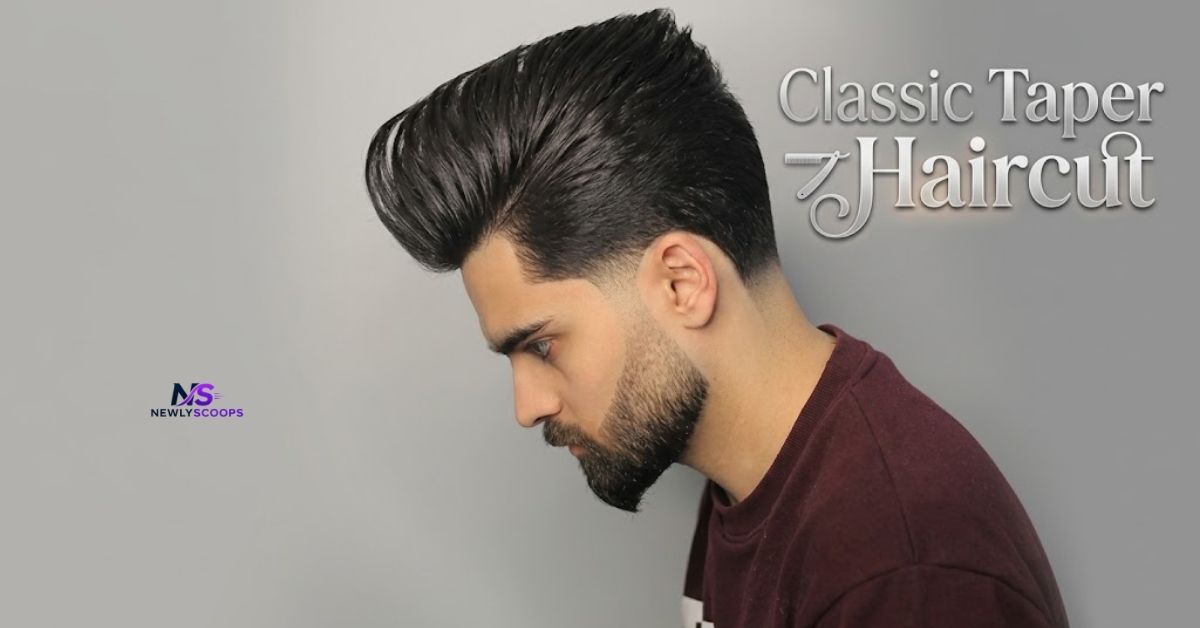
The Classic Taper Haircut remains one of the most adaptable men’s haircut choices because it balances a traditional silhouette with modern styling options. Longer hair on top, shorter sides, and a shorter back create a gradual transition rather than the abrupt skin exposure associated with many fade styles.
A Classic Taper Haircut can be tailored to straight hair, wavy hair, curly hair, coily hair, thick hair, or fine hair. Its natural hairline, tapered neckline, and controlled graduation make it suitable for a professional setting, everyday wear, formal events, and relaxed personal style.
This guide explains the structure, history, taper height, 65+ haircut variations, face-shape choices, hair-type recommendations, barber specifications, styling methods, maintenance schedule, and practical differences between a taper and fade.
What Is a Classic Taper Haircut and Is It Still Worth Getting in 2026?

A Classic Taper Haircut keeps most of the hair’s visual weight on top while the sides and back become progressively shorter toward the sideburns and neckline. The blended transition is subtle, so the finished silhouette looks clean without appearing aggressively faded.
The biggest advantage is versatility. A Classic Taper Haircut can look conservative with a side part, relaxed with natural texture, contemporary with a textured crop, or more dramatic with additional volume. That makes it a practical traditional men’s haircut for men who want one haircut that works across several settings.
KEY POINTS:
- Longer hair on top gives room for side parting, combing, brushing, or textured styling.
- Shorter sides and shorter back create structure without requiring skin exposure.
- A natural hairline and natural neckline preserve a softer grow-out.
- Low, mid, and high placement change the amount of contrast and visual width.
- The taper works with straight hair, wavy hair, curly hair, and coily hair.
- A professional barber can adjust the graduation according to hair density and hair texture.
- The style can be combined with a beard taper, sideburn blend, or shaped beard.
- A Classic Taper Haircut generally needs less frequent maintenance than a skin-level fade.
- It is appropriate for business formal, business casual, everyday wear, and many formal events.
- It remains a strong option for men who want a timeless haircut with a modern haircut option on top.
What is a classic taper haircut?
A Classic Taper Haircut is a men’s haircut built around a controlled reduction in hair length from the upper sides toward the ear area, sideburns, and neckline. The top generally stays noticeably longer, while the lower sections become shorter through hair graduation and hair blending.
The defining feature is the gradual transition. A taper does not normally remove all the hair down to exposed skin. Instead, the professional barber uses barber clippers, scissors, and clipper blending to create a clean shape while preserving the natural hairline.
The three key structural features are:
- Longer top: The top length can range from a short 1–2 inches to a longer 3–5 inches depending on the desired hairstyle.
- Graduated sides: The side length decreases progressively around the temples and ear area rather than disappearing abruptly.
- Preserved hairline: The neckline and sideburns can retain a natural appearance instead of being shaved completely.
A regular taper is often used as another name for this traditional structure. A businessman’s cut is another familiar description when the top is conservative and the styling is controlled.
The barber may use a #1 guard, #2 guard, #3 guard, or #4 guard as part of the progression. One eighth inch, one quarter inch, and longer lengths can be combined to create the desired contrast.
The exact clipper sequence should not be treated as universal. Hair thickness, hair density, head shape, and desired silhouette all affect the final barber specifications.
What does “classic” mean in the classic taper?
“Classic” describes the proportion and restraint of the haircut rather than one fixed clipper number. The classic haircut keeps the transition gradual, maintains a natural appearance, and avoids excessive skin exposure.
A Classic Taper Haircut can still have a modern haircut character. The difference is that the modern element usually comes from the top, texture, volume, parting, or styling product rather than an extremely high fade line.
“Classic” usually signals three things:
- Gradual contrast: The transition from longer hair to shorter hair is controlled.
- Preserved edges: The natural hairline and neckline remain visually important.
- Balanced proportions: The haircut is designed to look appropriate beyond one particular trend cycle.
That is why a classic haircut can move between generations. A traditional grooming approach can coexist with modern hair styling, textured tops, or a contemporary beard blend.
Is a regular taper the same as a classic taper?

In everyday barbering language, regular taper and classic taper often refer to the same basic haircut. Both normally describe a traditional taper haircut with longer hair on top and progressively shorter sides and back.
The important point is to clarify the taper height and top length. A barber may interpret “regular taper” differently from another barber if no additional specifications are given.
For a predictable barber appointment, explain the top length, side length, taper height, neckline, and desired finish. A reference photograph can remove even more ambiguity.
The phrase businessman’s cut usually implies a conservative version. The phrase professional haircut similarly suggests restrained contrast, clean edges, and manageable hair styling.
Classic taper vs. fade vs. taper fade: Key differences explained
The core difference between a taper and a fade is how far the reduction in hair length travels and how much skin exposure is created.
A classic taper gradually shortens the hair around selected areas such as the sideburns and neckline while retaining visible hair. A fade usually takes the graduation much closer to the skin and can extend farther around the sides and back.
A taper fade sits between those ideas. It may preserve a traditional upper structure while using a stronger fade finish around specific edges.
Quick comparison table
| Feature | Classic Taper | Taper Fade | Skin Fade / Bald Fade |
| Hairline | Usually preserved | More sharply defined | Often heavily reduced |
| Lowest length | Visible short hair | Very short to near skin | Skin-level |
| Contrast | Low to moderate | Moderate to high | High |
| Grow-out | Graceful | More visible | More noticeable |
| Formality | High | Medium-high | Medium or fashion-forward |
| Maintenance | Lower | Moderate | Higher |
| Best feature | Traditional structure | Hybrid appearance | Maximum definition |
Taper vs. fade
The taper is useful when you want a natural transition and preserved hairline. A fade is useful when you want stronger contrast, more skin exposure, and a sharper fade finish.
Neither is universally better. The best choice depends on lifestyle, workplace expectations, hair texture, facial proportions, and personal style.
Taper fade vs. classic taper
A taper fade haircut generally creates more visible contrast than a classic taper. A Classic Taper Haircut normally keeps the lower hairline softer and more traditional.
A low taper fade can look relatively conservative, while a high skin fade can create a much stronger visual effect. A professional barber can also create a middle ground with a subtle taper fade.
What is a classic taper fade?
A classic taper fade combines a traditional taper structure with a fade finish. Instead of taking the entire side and back to skin, the stronger fade effect is concentrated around selected areas.
The result is a blended transition that can look cleaner and sharper than a traditional taper while preserving much of its traditional silhouette.
Common versions include a low taper fade, mid taper fade, drop taper fade, and temple taper fade.
A Classic Taper Haircut with a fade finish is particularly useful for someone who likes traditional proportions but wants more definition around the neckline or temples.
The history of the classic taper haircut: Why it has lasted over 100 years
The history of the classic taper is closely associated with traditional grooming, military grooming standards, and the development of American barbershop culture. Neat, controlled hair became especially practical when men needed a professional appearance with limited daily styling.
During the early 20th century, military grooming encouraged short, functional hair. After World War II, returning servicemen helped carry those grooming expectations into civilian life.
The businessman’s cut became strongly associated with post-war America and Corporate America. During the 1940s, 1950s, and 1960s, a clean taper, controlled top, and side part were common symbols of professional presentation.
Hollywood also helped establish the look. Cary Grant, James Dean, and Paul Newman demonstrated different versions of the traditional men’s haircut, while later figures such as David Beckham and Ryan Gosling showed how the basic structure could be adapted to modern styling.
The haircut survived the changing 1970s, 1980s, and later decades because its underlying proportions are flexible. The top can become longer, shorter, textured, swept back, or naturally curly without changing the essential taper concept.
65+ classic taper haircut styles for men
The classic taper is better understood as a foundation than as a single fixed hairstyle. The following variations expand the traditional menu with different taper heights, top lengths, textures, facial-hair combinations, and styling directions.
Read More: 20 Kids Mullet Haircuts Your Child Will Love 2026
Low classic taper haircut styles
A low classic taper places the graduation low around the ear area and lower neckline. It creates a conservative silhouette and is particularly useful when the wearer wants low contrast.
1. Executive Low Taper
A controlled short top, clean side length, and subtle low graduation create a reliable professional haircut.
2. Low Taper + Side Part
The side part gives definition while the low placement keeps the overall shape conservative.
3. Low Taper + Comb Over
A comb over can add apparent fullness to fine hair while keeping the sides controlled.
4. Low Taper + Slicked Back
Longer hair on top is brushed backward for a polished finish.
5. Low Taper for Thick Hair
Bulk removal on top and careful clipper blending on the sides keep thick hair from becoming overly wide.
6. Low Taper + Ivy League
The Ivy League combines short length with enough top structure for a neat side direction.
7. Low Taper + Natural Texture
Minimal product allows the natural texture to remain visible.
8. Low Taper + Beard Blend
The sideburn blend connects the head hair to facial hair without creating a disconnected appearance.
9. Low Taper + Short Fringe
A controlled fringe can soften the forehead while maintaining a traditional side silhouette.
10. Low Taper + Crown Volume
Slight volume around the crown gives dimension without creating excessive height at the temples.
11. Low Taper + Soft Quiff
A restrained quiff adds visual height while keeping the haircut appropriate for everyday wear.
12. Low Taper + Textured Crop
A short textured crop creates a modern edge while the low taper keeps the overall haircut balanced.
Mid classic taper haircut styles (Medium taper)
A mid taper begins higher than a low taper, usually around the temple region. It provides more contrast while remaining less aggressive than a high taper.
13. Medium Taper + Textured Top
The top retains movement while the sides become progressively shorter.
14. Mid Taper + Textured Crop
A compact textured top pairs well with moderate side contrast.
15. Mid Taper + Pompadour
A pompadour uses added height and controlled volume for a more dramatic silhouette.
16. Mid Taper + Quiff
A quiff gives front-to-back movement without requiring the height of a full pompadour.
17. Mid Taper + Messy Quiff
Finger styling and matte paste create a relaxed finish.
18. Mid Taper + Natural Curls
Curly hair stays fuller on top while the mid graduation controls the sides.
19. Mid Taper + Slick Back
A longer top can be swept backward with pomade or styling cream.
20. Mid Taper for Wavy Hair
The wave pattern provides movement while the taper supplies structure.
21. Mid Taper + French Crop
A French crop creates a compact front fringe with a textured surface.
22. Mid Taper + Two Block
A carefully blended version can borrow proportions from Korean hairstyles and Japanese men’s styles.
23. Mid Taper + Comb Back
The comb-back keeps more natural separation than a wet-look slick back.
24. Mid Taper + Side Part
A side part adds facial balance and works particularly well in business casual settings.
High classic taper haircut styles

A high taper places the graduation higher and therefore creates more contrast between the top and sides.
25. High Taper + Crew Cut
The crew cut keeps the top short and practical, making this combination easy to maintain.
26. High Taper + Flat Top
The flat top produces a structured, retro shape with strong definition.
27. High Taper + Textured Spikes
Texture on top gives a sharper modern character.
28. High Taper for Curly Hair
The top can retain natural curls while the higher taper controls side bulk.
29. High Taper + Faux Hawk
The central section is styled upward for a subtle mohawk-inspired shape.
30. High Taper + Undercut Blend
A higher graduation can create an undercut-like impression while remaining blended.
31. High Taper + Textured Top
This pairing emphasizes contrast without requiring a skin-level finish.
32. High Taper + Soft Pompadour
Height on top balances the stronger side reduction.
Short classic taper haircut
A short taper keeps the top around 1–2 inches and prioritizes convenience, structure, and minimal daily styling.
33. Buzz Cut Taper
The top is clipped short while the neckline receives a controlled taper.
34. Crew Cut Taper
The front remains slightly longer than the back for a traditional American shape.
35. Butch Cut Taper
A nearly uniform short top gives a no-fuss finish.
36. Short Taper + Hard Part
A hard part introduces a deliberate line into an otherwise conservative haircut.
37. Short Taper + Textured Top
Small amounts of point cutting can add movement without requiring much styling.
38. Short Taper + Natural Edge
The barber preserves the natural hairline instead of forcing an artificial outline.
39. Short Taper + Beard
A subtle beard blend connects the short haircut to facial hair.
40. Short Taper + Rounded Neckline
A rounded neckline can soften the back silhouette.
Long classic taper haircut
A long taper generally keeps 3–5 inches or more on top. The longer top provides the greatest range of styling possibilities.
41. Long Slicked Back Taper
The hair is swept backward for a refined appearance.
42. Long Comb Back
The comb-back uses less rigid control and more natural movement.
43. Long Side Part Taper
A longer top makes the side part more prominent.
44. Long Pompadour Taper
Volume and taper contrast create a bold but structured look.
45. Long Flow Taper
The hair flows backward and sideways with minimal manipulation.
46. Long Wavy Taper
Wavy texture becomes the main styling feature.
47. Long Textured Fringe Taper
The fringe moves forward or sideways while the back and sides remain tapered.
48. Long Taper + Natural Curls
Curls stay expressive while the sides receive controlled graduation.
49. Long Taper + Top Knot
Longer hair can eventually be gathered into a top knot.
50. Long Taper + Man Bun
The taper supplies structure while the top remains long enough for a bun.
Classic taper fade styles

These variations introduce stronger fade elements while retaining a traditional upper structure.
51. Classic Low Taper Fade
The fade effect remains concentrated close to the bottom.
52. Classic Low Taper Fade + Side Part
The side part keeps the hybrid style suitable for business casual environments.
53. Classic Mid Taper Fade
The fade begins higher around the ear and temple region.
54. Classic Taper Fade + Curls
Curly texture on top contrasts with the cleaner sides.
55. Classic Taper Fade for Black Men
Natural texture, waves, twists, and coils can all be incorporated.
56. Classic Taper Fade + Waves
The wave pattern becomes the focal point while the edges remain defined.
57. Drop Taper Fade
The transition drops behind the ear and follows the head shape.
58. Temple Taper Fade
The emphasis is around the temples and sideburns.
Classic taper haircut with beard
A beard taper connects the head haircut with facial hair. The sideburn blend should be designed so that the transition looks intentional rather than abrupt.
59. Low Taper + Full Beard
A full beard gives the low taper additional weight around the lower face.
60. Mid Taper + Short Stubble
Short stubble keeps the overall grooming routine relatively simple.
61. High Taper + Shaped Beard
Stronger head contrast can be balanced with a defined beard line.
62. Taper + Short Stubble Blend
A gradual sideburn blend prevents a sudden break between head hair and facial hair.
Classic taper for Black men
A Classic Taper Haircut can work particularly well with natural hair when the barber understands hair density, coil direction, shrinkage, and the appropriate hair blending technique.
63. Classic Taper + Afro Top
The Afro top remains full while the sides receive controlled graduation.
64. Classic Taper + High Top
The high top creates visual height with tapered sides.
65. Classic Taper + Waves
360 waves can be paired with a low or mid taper.
66. Classic Taper + Twist-Out
Twists provide texture and volume while the sides remain structured.
67. Classic Taper + Short Dreads
Locs on top contrast with shorter tapered sides.
68. Classic Taper + Cornrows
Cornrows can be combined with controlled tapering around the edges.
69. Classic Taper + Long Braids
Long braids maintain length above a shorter side structure.
70. Temp Fade Taper
The temple area receives a more pronounced fade while the remaining structure stays controlled.
Additional classic taper variations
71. Classic Taper + Top Knot
Longer hair is gathered above a clean tapered foundation.
72. Classic Taper + Man Bun
A bun provides a stronger long-hair identity while the sides remain neat.
73. Classic Taper + Faux Hawk
The center is styled upward without the full commitment of a mohawk.
74. Classic Taper + Mohawk
The central strip remains dominant while the sides receive strong reduction.
75. Classic Taper + Blowout
Blow-drying creates volume and movement above the tapered sides.
76. Classic Taper with Design
A shaved line, geometric design, or subtle pattern adds a more fashion-forward element.
77. Classic Taper + Textured Fringe
A forward fringe adds texture while maintaining a clean lower silhouette.
78. Classic Taper + Hard Part
A hard line emphasizes the part and gives the traditional haircut a sharper detail.
79. Classic Taper + Brushed Top
Brushing creates a controlled direction without a high-shine finish.
80. Classic Taper + Side-Swept Top
A side sweep adds movement while retaining professional proportions.
Classic taper haircut for every face shape: Which style is right for you?
| Face Shape | Best Style Direction | Why It Works |
| Oval | Most taper heights | Balanced facial proportions allow flexibility |
| Round | Higher taper with controlled top height | Adds visual length |
| Square | Low or mid taper with softer texture | Complements strong jaw angles |
| Diamond | Low-mid taper with side part | Helps balance cheekbone width |
| Heart-shaped | Low taper with crown volume | Controls forehead emphasis |
| Oblong/Long | Low taper with width-focused top | Avoids excessive vertical length |
The best taper for face shape depends on height, width, jaw angle, forehead width, cheekbones, chin, and overall facial symmetry. A professional barber should consider the complete face geometry rather than selecting a taper height from a generic chart.
Classic taper for a round face
A round face often benefits from controlled height and reduced side bulk. A high taper + textured quiff can create visual length, while excessive side volume can make the face appear wider.
A high taper + pompadour can also work when the wearer enjoys stronger styling. Keep the top structured rather than excessively wide.
Classic taper for square face
A square face already has strong facial angles and a defined jawline. A low taper or mid taper with soft natural texture can complement those proportions without adding unnecessary angularity.
A side part, comb-back, or lightly textured top can create facial balance. Avoid excessive sharpness if the goal is a softer appearance.
Classic taper for oval face
An oval face offers considerable flexibility because facial width and length are generally balanced. Low taper, mid taper, and high taper choices can all work when the top length matches the wearer’s preferred silhouette.
Side parts, slick backs, textured tops, crops, quiffs, and natural styling are all practical options.
Classic taper for diamond face
Diamond faces often have prominent cheekbones with a narrower forehead and chin. A low-mid taper + side part can introduce useful width near the upper face.
A controlled top can also soften the transition between the cheekbones and forehead. Excessively high side reduction may make the cheekbones appear even wider.
Classic taper for a heart-shaped face
A heart face usually has a wider forehead and narrower chin. A low taper + crown volume can provide balance without adding excessive width near the temples.
A medium-length side part can also work well. Avoid creating too much height and width simultaneously.
Classic taper for oblong/long face
A long face generally benefits from width rather than additional vertical height. A low taper + flat top, textured crop, or side part can keep the silhouette visually balanced.
Very tall pompadours and high quiffs can add unnecessary visual length. A professional haircut should work with facial proportions rather than fight them.
Classic taper haircut for every hair type
Hair texture changes how the taper behaves. Straight hair shows clean lines clearly, while curly and coily textures require different approaches to bulk, shrinkage, and hair blending.
Classic taper haircut straight hair
Straight hair makes the gradual transition easy to see. A side part, comb over, slick back, or textured top can all work.
Pomade creates control and shine, while matte paste gives a more natural finish. Fine straight hair can benefit from moderate volume rather than heavy product.
Classic taper haircut wavy hair
Wavy hair provides natural movement. The taper removes excess side bulk while allowing the wave pattern to remain visible on top.
Sea salt spray, light styling cream, or light mousse can enhance waves without flattening them. Finger styling often looks more natural than aggressive combing.
Classic taper haircut curly hair
Curly hair benefits from a taper because controlled side length can reduce unwanted width while allowing natural curls to remain prominent on top.
A curl-defining cream can enhance natural curls, while light mousse can provide definition without excessive weight. The barber should account for shrinkage before deciding the top length.
Classic taper haircut with volume
Volume can be created through longer top length, blow-drying, mousse, styling cream, or strategic scissor work. The goal is not simply to make the hair taller; it is to control where the visual weight sits.
A Classic Taper Haircut with volume can be particularly effective on round faces when the added height is balanced against side length. On an oblong face, excessive height may be less appropriate.
Classic taper for thick hair
Thick hair needs careful bulk control. Removing weight from the wrong area can make the top look uneven, while leaving too much bulk around the sides can destroy the clean silhouette.
Point cutting, thinning shears, blending shears, and controlled scissor work can reduce weight while preserving useful length.
Classic taper for fine/thin hair
Fine hair can appear fuller when the side length is reduced and the top remains slightly longer. Excessive thinning shears can sometimes make fine hair appear weaker, so scissor work should be conservative.
A volumizing mousse or texture powder can create lift. A natural finish usually looks fuller than a heavy wet-look finish.
Classic taper for coily hair
Coily hair requires attention to curl behavior, density, shrinkage, and natural shape. A natural hair barber experienced with Type 4 hair can use clipper blending without destroying the top’s texture.
The taper should complement the natural hair rather than force a straight-hair silhouette onto a coily texture.
Classic taper haircut men

For men seeking a dependable haircut, the Classic Taper Haircut offers a strong combination of structure and flexibility. It can be short enough for an active lifestyle while retaining enough top length for hair styling.
The same foundation can also support a side part, textured crop, comb-back, quiff, or natural texture. That makes it practical for men who want several looks without changing the underlying haircut.
Classic Taper Haircut With Textured Top
A textured top gives the traditional taper a modern edge. Point cutting can create separation, while matte paste or styling cream can emphasize individual sections.
The sides should remain controlled so the texture on top remains the focal point. A low taper creates a conservative result, while a mid or high taper increases contrast.
Classic taper fade
A Classic Taper Haircut can be modified into a taper fade when the wearer wants more edge definition. The barber should specify exactly where the fade begins and whether the bottom reaches skin level.
A low taper fade is generally the easiest hybrid for someone moving from a traditional taper. A skin fade creates a much stronger contrast and requires more frequent fade maintenance.
Classic taper haircut straight hair
Straight hair works especially well with precise side parts, comb-backs, slick backs, and short textured tops. Because straight strands naturally reveal the haircut structure, the hairline and neckline need to be balanced carefully.
A low-shine finish can make straight hair appear polished without producing an overly formal wet look. A matte finish is useful for business casual styling.
Classic taper haircut curly hair
Curly hair changes the visual proportions of a taper because curls occupy more apparent volume. The barber should assess the hair in its natural state before deciding how much to remove.
A low taper can preserve more fullness, while a mid or high taper can create stronger contrast. The top should usually retain enough length for the curl pattern to form naturally.
Classic taper haircut with volume
Volume works best when it is deliberate. A longer top, controlled blow-drying, volumizing mousse, and appropriate brushing can create lift without producing an oversized silhouette.
For a business haircut, moderate volume is usually easier to manage than a dramatic pompadour. For creative professionals, more movement and texture can provide a modern haircut character.
Business classic taper haircut: The professional man’s guide
The Business Classic Taper is a conservative version designed for professional grooming. It works particularly well in law, finance, medicine, government, education, corporate environments, and other workplaces with clear dress expectations.
A typical business taper uses a low taper, moderate top length, clean edges, and a natural neckline. The top may be side-parted, combed back, or lightly textured.
Why the classic taper is the ultimate business haircut
- It works with conservative workplace expectations.
- It can look polished without appearing overly styled.
- It transitions well from office to everyday wear.
- It can be maintained without daily complex styling.
- It adapts to business formal and business casual environments.
- It suits job interviews and formal events.
- It works with suits, business casual clothing, and everyday clothing.
- It can be adjusted for different face shapes.
- It works with multiple hair textures.
- It retains a traditional silhouette while allowing a modern finish.
The Business Classic Taper Specification:
- Top length: approximately 2–2.5 inches for a controlled business look.
- Upper sides: around a #3 guard when appropriate.
- Lower sides: around a #2 guard, depending on density.
- Neckline: natural or tapered rather than an unnecessarily harsh line.
- Part: side part or controlled comb-back.
- Product: low-shine pomade, styling paste, or light styling cream.
- Finish: natural finish or matte finish.
- Maintenance: generally every 3–5 weeks depending on growth and preference.
Business classic taper vs. business casual taper
Business formal: Low taper, side part, natural neckline, controlled top, low-shine finish.
Business casual: Low or mid taper, textured top, natural movement, and a more relaxed styling product.
How to style the business classic taper for a job interview
Get the haircut several days before the interview rather than immediately beforehand. This gives the hair time to settle and lets any fresh barbering marks soften.
Use a restrained styling product and avoid an excessively glossy finish. A side part, comb-back, or lightly textured top is generally easier to read as professional than spikes or extreme volume.
A professional barber should also be told that the haircut is intended for a formal setting. That information helps guide the taper height, top length, neckline, and edge definition.
Why the classic taper is the best low-maintenance haircut for men
A taper is relatively forgiving during grow-out because the hair does not depend on one sharply exposed fade line. As the hair grows, the graduated sides can retain a natural appearance.
That does not mean every taper requires the same haircut frequency. Hair growth rate, hair density, neckline growth, and desired sharpness all matter.
Maintenance comparison table
| Haircut Style | Typical Refresh Pattern | Daily Styling |
| Classic Taper | About 4–6 weeks | Low |
| Taper Fade | About 3–4 weeks | Low-moderate |
| Skin Fade | About 2–3 weeks | Low |
| Undercut | About 3–5 weeks | Moderate |
| Pompadour | About 4–5 weeks | Higher |
How long does a classic taper last?
Many men can keep a taper presentable for around four to six weeks. Men who want very crisp edges may schedule a barber visit sooner.
Hair grows at different rates, so “half an inch per month” should be treated as an approximate planning figure rather than a universal rule.
At-home maintenance between barbershop visits
- Keep the neckline clean without trying to redesign it.
- Trim only obvious stray hairs if you are comfortable doing so.
- Avoid cutting into the upper taper.
- Keep sideburns consistent with the beard or facial hair.
- Wash according to scalp and hair needs rather than following a rigid schedule.
- Use moderate hair product to avoid unnecessary buildup.
- Brush or comb the top into its normal direction.
- Ask your barber for a touch-up if the neckline becomes distracting.
How to make your classic taper last longer
- Avoid repeatedly changing the neckline at home.
- Use lightweight styling products when possible.
- Protect the top from excessive heat.
- Maintain a consistent styling routine.
- Schedule the next barber appointment before the shape becomes difficult to restore.
- Tell your barber whether you prefer a tight initial taper or a softer grow-out.
How to ask your barber for a classic taper haircut
The easiest approach is to combine a reference image with a short verbal specification. A photograph communicates the desired silhouette, while barber specifications explain the technical details.
Tell the barber your preferred top length, taper height, neckline, and finish. Also mention whether you want a natural hairline, sharp edges, a beard blend, or a particular sideburn shape.
Step-by-step: How to ask for a classic taper
Step 1: Start with the style name
Say that you want a Classic Taper Haircut or regular taper.
Step 2: Specify the top length
Choose a target such as 1.5 inches, 2 inches, 2.5 inches, 3 inches, or longer depending on the desired styling.
Step 3: Specify the taper position
Say whether you want low placement, mid placement, or high placement.
Step 4: Confirm the neckline style
Ask for a tapered neckline, natural neckline, rounded neckline, or squared neckline according to your preference.
Step 5: Explain the sideburns
Mention whether you want natural sideburns, tapered sideburns, or a sideburn blend into facial hair.
Step 6: Describe the top
Say side part, comb-back, slick back, textured top, quiff, crop, curls, waves, or another preferred direction.
Step 7: Explain the finish
Choose natural, matte, low-shine, glossy, or wet-look styling.
Step 8: Show a reference photo
A good reference photograph can clarify proportions that words alone cannot fully describe.
Classic taper clipper guard reference table
| Head Area | Possible Guard | Approximate Length | Purpose |
| Upper sides | #3 or #4 | 3/8–1/2 inch | Retain side structure |
| Mid sides | #2 or #3 | 1/4–3/8 inch | Create transition |
| Lower sides | #1 or #2 | 1/8–1/4 inch | Tighten lower area |
| Neckline | #1 or shorter | Around 1/8 inch or below | Finish graduation |
| Top | Scissors or longer clipper guard | Varies | Preserve styling length |
Guard numbers are a communication tool, not a universal recipe. A #1 guard is approximately 1/8 inch, a #2 is approximately 1/4 inch, a #3 is approximately 3/8 inch, and a #4 is approximately 1/2 inch, although clipper systems can vary.
A barber may combine clippers with scissors, thinning shears, blending shears, point cutting, and freehand work. The final haircut execution should follow the head shape and hair texture rather than a rigid numerical sequence.
How to style a classic taper haircut: Step-by-step
Styling begins with clean hair and a product appropriate to the desired finish. The amount of product should match the top length, hair density, and styling direction.
Step-by-step styling guide
- Begin with clean, towel-dried hair.
- Apply a small amount of styling product.
- Spread the product thoroughly between your hands.
- Work it through the top rather than concentrating it on the scalp.
- Use a comb for precise structure or fingers for natural movement.
- Create a side part if desired.
- Sweep the hair backward for a comb-back.
- Use a blow dryer when additional volume is needed.
- Use a round brush for pompadours or quiffs.
- Finish with a small amount of texture product if extra separation is needed.
- Avoid repeatedly adding product throughout the day.
- Rework the hair with slightly damp hands when possible.
Best styling products for a classic taper (by finish type)
| Look / Finish | Product | Best For |
| Natural / Matte | Matte paste or clay | Everyday styling |
| Low Shine | Styling cream | Longer tops |
| Glossy | Pomade | Side parts and slick backs |
| Textured | Sea salt spray + paste | Wavy or relaxed styles |
| Volume | Volumizing mousse | Fine hair and quiffs |
| Curl Definition | Curl-defining cream | Curly and coily hair |
| Strong Hold | Strong-hold product | Thick hair and formal styles |
Pomade is useful when the goal is controlled movement and shine. Matte pomade or matte paste works better when a natural finish is preferred.
Styling cream can preserve movement in longer hair. Sea salt spray can enhance waves, while curl-defining cream can support natural curls. Texture powder can provide lift without creating a heavy glossy coating.
Classic taper haircut: Celebrity inspiration and reference guide
Celebrity examples are useful for identifying broad styling directions, but they should not be treated as exact barber specifications. Hair density, facial proportions, texture, and natural hairline differ from person to person.
Cary Grant: Traditional refinement
Cary Grant is strongly associated with polished classic grooming. His controlled top and neat sides demonstrate how traditional proportions can create sophistication without extreme contrast.
James Dean: Classic structure with youthful texture
James Dean showed how a traditional men’s haircut could be paired with more movement and personality. The lesson is that natural texture can modernize a conservative silhouette.
Paul Newman: Balanced everyday grooming
Paul Newman frequently demonstrated the value of proportion. Moderate top length and controlled sides can remain masculine and relaxed without looking unfinished.
David Beckham: Modern adaptation
David Beckham has worn many taper variations, including side parts, slick backs, textured tops, and more contemporary styling. His hairstyles demonstrate how taper height and top length can alter the overall silhouette.
Ryan Gosling: Refined simplicity
Ryan Gosling has frequently worn understated short sides with controlled top styling. A restrained taper paired with a clean part or natural top can work well when the goal is polished simplicity.
Jonah Hill: Texture and facial balance
Jonah Hill has worn textured top styles that demonstrate how additional height and movement can influence visual facial length. This is especially relevant when considering a taper for a rounder face.
The Celebrity Takeaway: the strongest lesson is not to copy a celebrity haircut literally. Instead, identify the top length, taper height, texture, styling direction, and facial proportions that make the reference appealing, then translate those characteristics into barber instructions suited to your own hair.
Frequently Asked Questions
What is a classic tapered haircut?
A classic tapered haircut gradually reduces hair length around the sides and back while retaining more length on top. The transition is blended, and the lower neckline and sideburn areas usually retain visible hair rather than being taken completely to skin.
Which is better, a taper or fade?
Neither is automatically better. A taper is generally better for someone who wants a traditional silhouette, softer grow-out, and lower visual contrast. A fade is better when stronger definition, higher contrast, or skin exposure is the goal.
How do I ask for a classic taper haircut?
Tell your barber the desired top length, taper height, neckline, sideburn treatment, and styling direction. A useful specification is a natural tapered neckline with a low, mid, or high taper and enough top length for your chosen hairstyle. Bring a reference photograph whenever possible.
Is a taper high, mid, or low?
A taper can be low, mid, or high. Low placement keeps the graduation closer to the ear and neckline, mid placement raises it toward the temple, and high placement creates more contrast by beginning the reduction higher on the head.
What looks better, mid taper or low taper?
A low taper usually looks more conservative and traditional, while a mid taper creates more contrast and a more noticeable modern edge. The better option depends on face shape, hair density, workplace requirements, preferred styling, and how much contrast you want.
Conclusion
The Classic Taper Haircut remains a versatile choice because its foundation is simple while its styling possibilities are extensive. Low, mid, and high placement can change the silhouette, while top length, texture, volume, facial hair, and neckline design allow the haircut to be personalized.
Whether you prefer a businessman’s cut, textured top, side part, curls, waves, beard blend, or longer styling, the key is precise communication with your barber. Match the taper height to your face shape and lifestyle, choose a practical maintenance schedule, and let your natural hair texture guide the final execution.
